
Designing for Digital Therapeutics: Behavioral Architecture and Patient Adherence
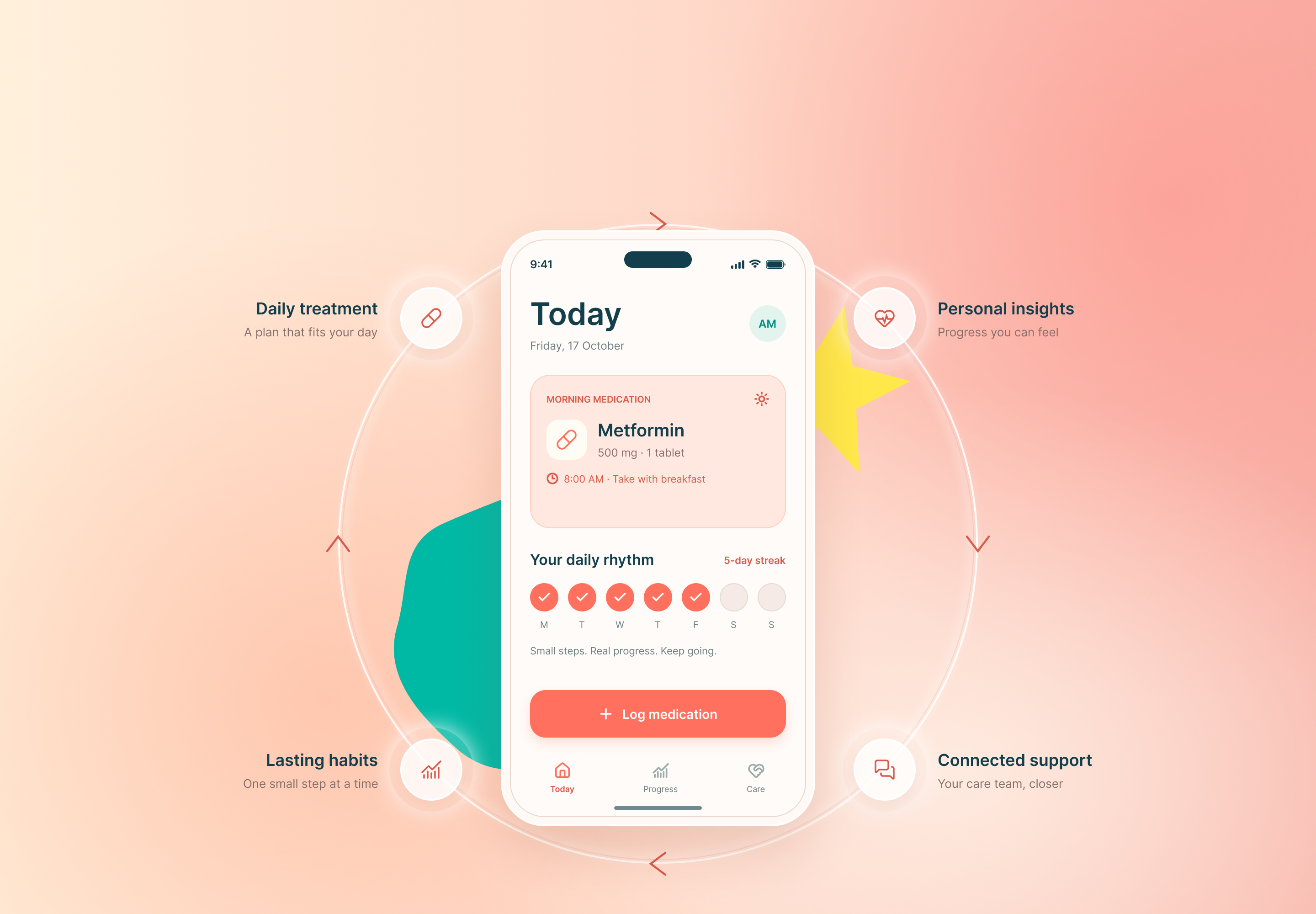
A prescription app that patients delete in week two is not a therapeutic. It is a download.
Digital therapeutics (DTx) live or die on adherence, because the clinical effect depends on dose, and the dose is behavior. A cognitive behavioral therapy module that gets used for three sessions out of twelve has delivered a quarter of the intervention. Most DTx teams treat this as a marketing problem. It is a design problem, and it has a structure.
Adherence Is the Active Ingredient
A pill works whether or not the patient feels motivated. Software does not. The patient must open it, complete the task, and return tomorrow, often while managing depression, chronic pain, or a diabetes regimen that already consumes attention.
That reality demands behavioral architecture: deliberate design of the conditions under which a target behavior becomes easy, cued, and rewarding. The most useful working model is the Fogg Behavior Model, which holds that action occurs when motivation, ability, and a prompt converge. Patients with chronic conditions have unstable motivation. So the reliable levers are ability and prompts. Make the task smaller. Time the cue better.
The Engagement Loop Framework
Sustained adherence comes from loops, not features. A workable DTx loop has four stages.
- Trigger. A cue tied to a real routine, such as a morning medication or an evening wind-down, rather than an arbitrary push notification.
- Action. A task completable in under two minutes on the worst day. Long sessions can exist, but a minimum viable version must always be available.
- Variable feedback. Output that shows the patient something true about their condition: a symptom trend, a sleep pattern, a streak of completed exposures.
- Investment. A small contribution that makes tomorrow’s return more likely, such as logging a goal, naming a trigger, or scheduling the next session.
Each stage has a failure mode. Triggers that ignore context train users to swipe them away. Actions that demand twenty minutes fail on exactly the days the patient needs them most. Feedback that is generic reads as noise. Investment that feels like homework backfires.
Motivation Design That Survives Bad Weeks
Motivation follows a curve, and the curve drops. Early enthusiasm fades by the second or third week. Design for the trough.
Self-determination theory gives three levers that hold up in clinical populations: autonomy, competence, and relatedness.
- Autonomy. Let patients choose the order of modules, the time of reminders, or the goal they work on first. Forced paths breed resistance.
- Competence. Show progress against the patient’s own baseline, not against an abstract ideal. A person whose pain diary improved slightly should see that, not a mostly empty progress ring.
- Relatedness. Connect the work to a clinician or care team. A visible note such as “your care team reviews this weekly” outperforms any badge.
A word of caution on gamification. Points and streaks can sustain behavior, but streak mechanics punish a missed day with a visible loss. For a patient in a depressive episode, that loss can trigger shame and abandonment. Build in forgiveness: freeze days, graceful resets, and language that treats a gap as data rather than failure.
Also plan for relapse in engagement. A patient who disappears for nine days needs a re-entry path that asks little and judges nothing, not a cascade of escalating reminders.
Consent as a Product Surface
Adherence design depends on data. Engagement loops need behavioral signals, and clinical validation needs outcome measures. Under GDPR, collecting that data is a legal and design problem at once, because health data is a special category under Article 9 and requires an explicit legal basis.
Most DTx consent flows fail the test in practice. A single “I agree” button after a wall of legal text meets the form of consent and misses its substance. GDPR requires consent to be freely given, specific, informed, and unambiguous, and the patient must be able to withdraw as easily as they gave it.
GDPR-Compliant Collection Models That Keep Consent Meaningful
Four patterns turn consent from a checkbox into a working control.
- Granular, purpose-separated consent. Treat treatment delivery, product analytics, and research use as separate purposes with separate toggles. Bundling them invalidates consent for the optional ones.
- Layered notices. Lead with a plain-language summary of what is collected and why, in a few short lines. Place the full policy one tap away. Patients make real decisions from the first layer.
- Just-in-time requests. Ask for access to a sensor, location, or contact list at the moment the feature needs it, with a sentence explaining the benefit. Requesting everything at onboarding produces reflexive acceptance or abandonment.
- A persistent privacy dashboard. Give patients one screen to review what they shared, change permissions, export their data, and delete it. Withdrawal must take no more effort than the original opt-in.
Apply data minimization as a design discipline. For every field, ask what clinical or product decision depends on it. If no decision does, do not collect it. Fewer fields also mean shorter onboarding, which helps adherence directly. Where possible, use pseudonymization for analytics and keep identifiers separate from behavioral data.
Note the tension. The same transparency that protects the patient can lower opt-in rates for optional data. Accept that cost. Consent obtained through friction removal or dark patterns is not consent, and regulators and notified bodies increasingly examine it.
Measuring What Actually Predicts Outcomes
Downloads and registrations say little. Track the metrics that tie to the clinical dose.
- Completion rate by module, to locate where patients drop.
- Time to first meaningful action, measured from install.
- Day-7 and day-30 retention, segmented by trigger type.
- Minimum-version usage, showing whether the low-effort path rescues bad days.
- Consent withdrawal and opt-in rates by purpose, read as design feedback.
- Re-engagement rate after a gap of a week or more.
Link these to the clinical endpoint your trial or real-world evidence study uses. A retention curve that does not correlate with symptom change is a vanity metric, and payers will notice.
Build the Loop, Then Earn the Data
Audit your product this week. Count the taps between launch and the first completed task. Read your consent screen as a patient would, in thirty seconds, and see whether you can state what you agreed to. Check whether withdrawing consent takes more steps than granting it.
Adherence and consent share a root: respect for the patient’s limited time and real autonomy. Design for both, and the data your product needs becomes data patients are willing to give.