
Clinical-Grade Digital Capabilities
We combine four core UI/UX pillars with absolute medical safety compliance, so every research insight, interaction, animation, and interface is built to satisfy clinicians, patients, and auditors alike.
- HIPAA-aware
- GDPR-ready
- WCAG 2.2 & Section 508
Capabilities Index
04 disciplines01
User Research
Clinical context meets human behavior.
Qualitative ResearchDeep user insights for product clarity.
METHODOLOGY TOOLBOX (Tailored to your scope):
- User Interviews
- Contextual Inquiries
- Field Studies
- Ethnographic Research
- Focus Groups
- Diary Studies
- Empathy Mapping
- Persona Creation
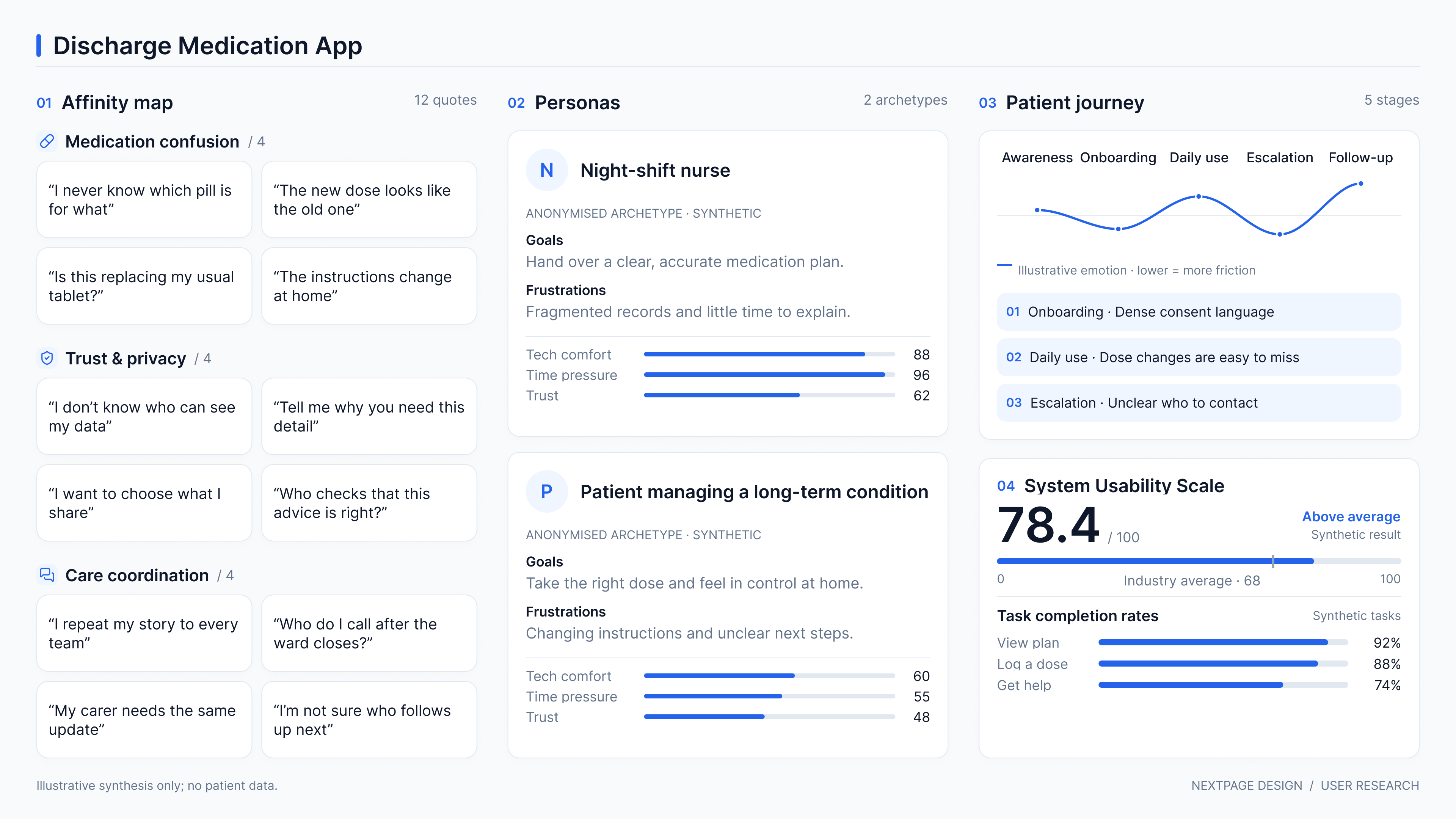
- Affinity Mapping
- Journey Mapping
- Card Sorting
- Usability Testing
- Heuristic Evaluation
- Cognitive Walkthroughs
DELIVERABLES:
- 1 Contextual InquiriesDirectly observing and shadowing users in their actual environments to map their true routines and distractions.
- 2 Longitudinal Patient Journey MapsVisual blueprints detailing how patients interact with your digital health tool throughout their entire treatment lifecycle, chronic care management, or recovery phase.
- 3 Use-Error Risk IdentificationA detailed breakdown highlighting exactly where users misinterpret visual prompts, misread medical data layers, or face a high risk of making a critical medical entry error.
- 4 Cognitive Walkthrough & Fatigue AnalysisEvaluating interfaces to pinpoint where users experience mental exhaustion, choice paralysis, or cognitive load drop-offs during long clinical shifts.
- 5 Clinical Persona & Environment MatricesDeeply researched user profiles outlining the technical literacy, emotional states, physical environments, and precise motivations of your target patient or provider population.
- 6 Qualitative Human Factors Formative ReportsComprehensive, structured insights detailing prioritized UX recommendations and user quotes designed to align your design engineering with FDA-safe usage methodologies.
Quantitative ResearchData-driven metrics to scale decisions.
METHODOLOGY TOOLBOX (Tailored to your scope):
- Surveys
- A/B Testing
- Remote A/B Testing
- Tree Testing
- Heat Mapping
- Web Analytics
- Click Stream Analysis
- System Usability Scale (SUS)
- Net Promoter Score (NPS)
- Customer Satisfaction (CSAT)
- Key Performance Indicators (KPIs)
DELIVERABLES:
- 1 Critical Use-Error Rate trackingStatistical tracking mapping how many users successfully execute high-stakes workflows without error.
- 2 Time-to-Task Efficiency BenchmarksHard data measuring how fast a user can complete a task under intense, simulated time pressure.
- 3 Standardized Psychometric AuditsDeploying industry-validated frameworks like the System Usability Scale (SUS) or UMUX-Lite to measure baseline system complexity against clinical benchmarks.
- 4 Behavioral Conversion & Drop-off FunnelsPinpointing the exact layout coordinates and steps where patients or healthcare providers abandon multi-step onboarding sequences.
- 5 High-Volume Heatmaps & Click-Map AnalyticsVisual tracking aggregating thousands of user sessions to see what data layers users focus on and what features get entirely ignored.
- 6 Quantitative Human Factors Data ReportsComprehensive, audit-ready data decks structured to provide the safe and effective performance metrics demanded by healthcare investors and the FDA.
02
Interface Design
Interfaces clinicians trust and patients can use.
Web DesignCredible sites that convert.
METHODOLOGY TOOLBOX (Tailored to your scope):
- Wireframing
- Information Architecture
- Design Systems
- Responsive Layouts
- Accessibility Audits (WCAG 2.2)
- Front-End Prototyping
- Content Strategy
- Component Libraries
DELIVERABLES:
- 1 Sitemap & Patient/Provider IAInformation Architecture designed for dual audiences.
- 2 Medical Copy & Compliance DirectionTone-of-voice that speaks to clinicians and legal boards.
- 3 Compliant WireframesLayouts built strictly to WCAG accessibility and role-based data standards.
- 4 High-Fidelity UI MockupsEnterprise-grade, institutional-quality design aesthetics.
- 5 Cross-Platform Responsive DesignFlawless layouts optimized for desktop workstations and mobile devices.
- 6 Interactive Product SimulatorsStructured sites that answer buyer, compliance and integration questions up front.
App DesignIntuitive iOS and Android app experiences.
METHODOLOGY TOOLBOX (Tailored to your scope):
- Mobile Wireframing
- Interactive Prototyping
- iOS & Android Guidelines
- Onboarding Flows
- Accessibility Testing
- Design Tokens
DELIVERABLES:
- 1 Patient & Provider Mobile IAInformation architecture optimized for small screens, quick logging, and low cognitive load.
- 2 Cross-Platform UI KitsNative iOS and Android component libraries designed using strict Apple Human Interface and Material Design standards.
- 3 Mobile Accessibility ComplianceInterfaces strictly matching WCAG 2.2 color contrast and text-scaling for patients with visual or physical impairments.
- 4 High-Fidelity App MockupsPixel-perfect layouts and screens for your app.
- 5 Gesture & Micro-interaction BlueprintsDeliberate user patterns engineered to prevent accidental screen taps or critical medical input errors.
- 6 Interactive Mobile PrototypesClickable, high-fidelity app simulations ready for patient testing, engineering handoff, or investor pitches.
Wearable DesignCompact UI engineered for smart devices.
METHODOLOGY TOOLBOX (Tailored to your scope):
- Glanceable Layouts
- Micro-Interaction Design
- Haptic Mapping
- Small-Screen Typography
- Alert Prioritization
- Device Prototyping
DELIVERABLES:
- 1 Glanceable Information ArchitectureLayout systems engineered specifically for ultra-small screen sizes, prioritizing immediate readability of vital signs.
- 2 Contextual Alert & Notification MatricesVisual and haptic alert patterns designed to instantly cut through distraction during low-battery or high-risk medical alerts.
- 3 High-Contrast Component LibrariesSpecialized UI elements optimized for extreme ambient lighting conditions, from bright sunlight to pitch-black clinical environments.
- 4 Accessibility & Motor-Constraint LayoutsTap targets, swipe zones, and typography optimized for patients dealing with age-related vision decline, tremors, or physical limitations.
- 5 Cross-Device Data Sync BlueprintsSeamless interface continuity mapping how data transitions instantly between the wearable device, smartphone apps, and provider dashboards.
- 6 Human Factors Compliance AssetsRigorous UI documentation and interactive mockups structured to pass strict FDA and IEC 62366 human factors usability audits.
Presentation DesignHigh-stakes pitch decks built for investors.
METHODOLOGY TOOLBOX (Tailored to your scope):
- Narrative Structuring
- Storyboarding
- Data Visualization
- Slide Systems
- Brand Alignment
- Speaker Notes
DELIVERABLES:
- 1 Narrative Architecture & FlowStructuring complex medical and commercial data into a persuasive, high-impact storytelling sequence.
- 2 Data & Clinical Chart VisualizationTransforming dense medical studies, efficacy trials, and market analytics into beautiful, easily scannable graphics.
- 3 Institutional Pitch LayoutsPremium, ultra-clean visual design tailored specifically to command authority in front of VC firms and healthcare executives.
- 4 Custom Medical Asset IntegrationPolished vector graphics, compliant UI screenshots, and product diagrams that perfectly mirror your actual software.
- 5 Interactive Demo Slide FlowsFrictionless, clickable presentation sections that seamlessly simulate your healthcare platform's core user experience.
- 6 Master Templates & Style GuidelinesFully editable, modular slide kits built in Figma, PowerPoint, or Google Slides for your internal team's future sales use.
Gamification FrameworksEngaging mechanics that boost user retention.
METHODOLOGY TOOLBOX (Tailored to your scope):
- Behaviour Mapping
- Reward Loop Design
- Progress Visualization
- Streak & Milestone Design
- Social Incentive Design
- Motivation Testing
DELIVERABLES:
- 1 Behavioral Mechanics & Loop MappingDesigning positive reinforcement loops, habit triggers, and intrinsic motivation mechanics based on psychological framework standards.
- 2 Empathetic Progress ArchitectureVisual tracking systems, milestone markers, and leveling structures designed to encourage patients without causing stress or fatigue.
- 3 Micro-Incentive & Reward EconomiesContextual, health-appropriate reward systems that celebrate micro-wins like a 7-day streak of logging blood sugar levels.
- 4 Bite-Sized Health Education FlowsTransforming dense, boring clinical instructions into interactive, easily digestible visual learning paths and quiz layouts.
- 5 Accessibility-First Engagement KitsGamified elements engineered to remain fully inclusive for elderly patients or individuals experiencing severe cognitive overload.
- 6 High-Fidelity Simulation PrototypesClickable, high-fidelity app simulations ready for patient retention testing, investor pitches, or clinical trial deployment.
Add your video: videos/continuum-connected-care.mp4
03
Interaction Design
Flows that guide, reassure and prevent errors.
IconographyCustom vector icons for product interfaces.
METHODOLOGY TOOLBOX (Tailored to your scope):
- Icon Style Direction
- Icon Set Libraries
- Pictogram
- Grid & Keyline Systems
- Icon Naming & Export Specs
- Accessibility & Legibility Testing
- Medical Symbol Standardization
DELIVERABLES:
- 1 Clinical-Grade Custom Icon SetsDesigning bespoke, monoline vector symbols for complex medical concepts, like specialized surgical equipment, anatomical layers, or pharmaceutical dosage forms that cannot be found in generic icon libraries.
- 2 ISO & IEC Hazard AlignmentMapping error states, physiological alerts, and emergency system messages to strict international healthcare design standards, including ISO 7010 and IEC 60601-1-6.
- 3 Pixel-Perfect Scale OptimizationDeveloping geometric icon grids built to maintain flawless visual legibility and recognizable shapes at micro-sizes, such as small smartwatch screens or crowded EHR data grids.
- 4 Accessibility & Low-Vision OptimizationEngineering high-contrast line-weights and universally recognizable outer silhouettes tailored for elderly patients or individuals with low visual acuity.
- 5 Dual-Context Visual Semantic RulesEstablishing clear icon treatments that cleanly distinguish between patient-facing tools focused on empathy and clarity; clinical platforms built for high density and rapid scanning.
- 6 Master Icon Component LibraryDelivering an exhaustively tagged, production-ready SVG or icon-font kit within Figma and code repositories, complete with role-based naming conventions for rapid developer implementation.
Design SystemsReuseable UI components built to scale.
METHODOLOGY TOOLBOX (Tailored to your scope):
- Design Token Architecture
- Component Libraries
- Pattern Documentation
- Accessibility Standards
- Figma Library Setup
- Developer Handoff Specs
DELIVERABLES:
- 1 WCAG 2.2-Compliant Token ArchitectureEstablishing a unified foundation of semantic design tokens(colors, type scales, and spacing), hard-coded to meet strict global accessibility contrast laws.
- 2 Cross-Platform Medical Component KitDeveloping an exhaustive, pixel-perfect Figma library of clinical-grade UI elements, from complex laboratory charts to dense EHR data tables.
- 3 Role-Based Security Layout PatternsDesigning reusable UI shell configurations that dynamically adapt layouts based on user access levels to protect sensitive patient data.
- 4 Human Factors Validation DocumentationProviding comprehensive usability blueprints detailing the exact behavioral rationale behind components to streamline regulatory approval cycles.
- 5 Code-Aligned Component HandoffBridging the design-to-development gap by mapping Figma components directly to production-ready code repositories like React, Tailwind, Swift, or Flutter.
- 6 Storybook & Master Documentation HubDeploying documentation that contains comprehensive governance policies and usage guidelines for your entire cross-functional team.
Userflow DesignFrictionless path from landing to conversion.
METHODOLOGY TOOLBOX (Tailored to your scope):
- Taskflow Mapping
- Decision Point Analysis
- Role-Based Flow Mapping
- Journey-to-Flow Translation
- Flow Validation Walkthroughs
- Edge Case & Error Path Mapping
DELIVERABLES:
- 1 Workflow Optimization ChartsMapping and consolidating complex routines into hyper-efficient digital pathways that reduce the clicks required to perform an action like order prescriptions or log patient data.
- 2 Cross-Persona Dual User PathwaysDesigning parallel, interconnected navigation tracks that seamlessly handle the distinct technical needs of target audience.
- 3 HIPAA-Compliant Authentication LoopsEngineering secure, frictionless user pathways for high-security events, such as multi-factor login overrides or timed biometric session logouts.
- 4 Exception & Error-Recovery Flow MapsMeticulously charting edge cases and system recovery pathways to ensure software safely redirects users if a medical device disconnects or a data upload fails.
- 5 Multi-State Branching ArchitectureDeveloping master structural blueprints detailing how user journeys change dynamically based on incoming data, inputs, or risk levels.
- 6 Complete Low-Fidelity Interactive WireflowsDelivering early-stage, clickable navigational layouts that allow your engineering team and advisory boards to validate structural logic before visual design begins.
Information ArchitectureClear sitemaps and organized content.
METHODOLOGY TOOLBOX (Tailored to your scope):
- Content Audit
- Card Sorting
- Content Hierachy Mapping
- Sitemap Creation
- Navigation Modeling
- Taxonomy & Labelling Systems
DELIVERABLES:
- 1 Visual Hierarchy BlueprintingStructuring complex screens to ensure that critical information instantly commands focus over secondary administrative data.
- 2 Cross-Persona Taxonomy & LabelingDeveloping a highly standardized, unambiguous terminology system that maps cleanly to the mental models of both specialized and everyday users.
- 3 Deep-Data Navigation & Menu Trees Engineering intuitive nested navigation schemas that allow users to seamlessly drill down into granular tasks in less than three clicks.
- 4 Role-Based Information Display RulesDesigning adaptive layout structures that dynamically prioritize or hide specific data segments based on whether the logged-in user is a physician, billing admin, or patient.
- 5 Search & Filtering FrameworksBuilding advanced, predictive search schemas optimized for rapid filtering across massive medical databases, diagnostic codes, and longitudinal health records.
- 6 Master Sitemap & Structural IA SpecsDelivering comprehensive, interactive data-mapping blueprints that serve as the definitive structural foundation for both your design phase and engineering pipeline.
Usability & AccessibilityWCAG-Complaint designs for all users.
METHODOLOGY TOOLBOX (Tailored to your scope):
- WCAG 2.2 Audits
- Screen Reader Testing
- Keyboard Navigation Mapping
- Color Contrast Review
- Cognitive Load Review
- Section 508 Checks
DELIVERABLES:
- 1 WCAG 2.2 & Section 508 Conformance AuditConducting an exhaustive evaluation of your existing platform across all compliance levels to identify and catalog code-level and visual accessibility failures.
- 2 Cognitive Load & Friction AssessmentAnalyzing interfaces under simulated high-stress conditions to identify elements that trigger user anxiety, mental fatigue, or navigation drops.
- 3 Assistive Tech Navigation MappingOptimizing layouts to ensure total compatibility with external assistive technologies, including screen readers, switch-control devices, and voice-command software.
- 4 Inclusive Assistive Contrast & Sizing MatricesDesigning accessible typographic scales, enhanced touch-target zones, and robust color contrast frameworks tailored for low-vision and motor-impaired users.
- 5 Multi-Scenario Usability Remediation BlueprintDelivering an actionable, prioritized step-by-step design roadmap mapping exactly how to fix compliance gaps without breaking your underlying product architecture.
- 6 FDA Human Factors Engineering DocumentationStructuring comprehensive usability verification reports and testing data tailored to seamlessly clear strict institutional compliance and regulatory review boards.
Wireframing & PrototypingRapid interactive models to test ideas.
METHODOLOGY TOOLBOX (Tailored to your scope):
- Low-Fidelity Sketching
- High-Fidelity Prototypes
- Clickable Demos
- Usability Test Prep
- Responsive Layout Planning
- Component Placement Studies
DELIVERABLES:
- 1 Low-Fidelity Structural WireframesDeveloping rapid, monochrome screen blueprints focused purely on structural content hierarchy, data placement, and foundational navigation logic.
- 2 Formative Simulation MapsStructuring targeted, task-based wireframe pathways designed specifically to gather early feedback from directors and advisors.
- 3 High-Fidelity Interactive PrototypesBuilding clickable, high-fidelity digital product simulations in Figma that look, feel, and behave like fully developed medical software.
- 4 Human Factors Evaluation PrototypesConfiguring specialized prototype variants engineered for rigorous user simulation testing, complete with multi-state logic and error-handling conditions.
- 5 Stakeholder & Investor Pitch PrototypesCreating cinematic, high-converting interactive software flows designed to showcase your core value proposition clearly during high-stakes funding rounds.
- 6 Developer-Ready Flow AnnotationsDelivering exhaustively documented prototyping blueprints that map out every click, hover, conditional branch, and transition to eliminate developer guesswork.
Add your video: videos/patient-onboarding-consent.mp4
04
Motion Design
Movement that confirms, guides and stays calm.
Micro InteractionsMovement that confirms and guides.
METHODOLOGY TOOLBOX (Tailored to your scope):
- Interaction Triggers
- Easing & Timing Specs
- Feedback Loops
- State Change Mapping
- Prototype Animation
- Reduced-Motion Alternatives
DELIVERABLES:
- 1 Destructive Action Safeguard StatesDesigning multi-state, high-friction button transitions and slide-to-confirm animations that physically stop accidents like record deletions.
- 2 Contextual Alert Response SystemsDeveloping pulse frequencies, expanding focus animations, and synchronized haptic rhythms that immediately anchors users eye to alerts.
- 3 System State & Async Loading CuesBuilding continuous, clear-status progress animations that let users know exactly when a high-bandwidth diagnostic report is downloading or processing.
- 4 Cognitive Spatial TransitionsCreating logical screen-to-screen panning and card-expansion motions that preserve a user's mental model of complex EHR or patient record databases.
- 5 Patient Progress & Milestone PhysicsDeveloping warm, encouraging UI micro-animations and physics-based celebrations that organically reward patients for logging wellness metrics.
- 6 Interactive Lottie & Code-Ready HandoutsExporting lightweight, production-grade JSON or Lottie files alongside precise timing specs to guarantee pixel-perfect engineering deployment.
System Motion GuidelinesScalable animation rules for teams.
METHODOLOGY TOOLBOX (Tailored to your scope):
- Motion Principles
- Motion Token Systems
- Easing & Timing Specs
- Choreography & Sequencing Rules
- Platform Adaptation
- Accessibility & Reduced-Motion Rules
DELIVERABLES:
- 1 Global Easing & Timing TokensDeveloping a standardized set of mathematical easing curves and duration tokens engineered specifically for rapid, predictable medical software navigation.
- 2 Motion Accessibility (Vestibular) PoliciesDesigning strict system overrides that instantly disable intense panning or scaling effects for patients sensitive to motion-induced vertigo or nausea.
- 3 Component Motion ChoreographyMapping universal entrance, exit, and expansion rules for global UI components like modals, dropdowns, and sticky notification banners.
- 4 Hardware-Optimized Performance RulesEstablishing frame-rate-friendly animation guidelines that prevent lag and layout shifts on low-spec legacy tablets or outdated clinical monitors.
- 5 Cross-Platform Handoff SpecificationsDelivering code-agnostic animation parameters alongside native implementation guidelines for React, iOS Swift, Android Kotlin, and Web components.
- 6 Master Motion DocumentationBuilding a live guide within your design system or Storybook, detailing exactly how and when to apply motion safely across your ecosystem.
Loading & Progress FeedbackEngaging wait states that reduce churn.
METHODOLOGY TOOLBOX (Tailored to your scope):
- Skeleton Screens
- Progress Indicators
- Perceived Performance Review
- Timeout & Retry States
- Empty State Design
- Animation Prototyping
DELIVERABLES:
- 1 Actionable Clinical Empty StatesDesigning helpful placeholder screens that clearly state when data is absent.
- 2 Contextual Skeleton Loadersprogressive layout blocks that mimic the shape of incoming medical charts, lowering perceived wait times and showing users exactly where text or data will appear.
- 3 High-Bandwidth Processing Feedbackdescriptive loading animations that update clinicians on complex backend actions, such as "Analyzing MRI scans..." or "Syncing EHR database..."
- 4 Network Disconnection Recovery UIDesigning resilient offline layouts that explicitly tell doctors when internet connectivity drops, ensuring they know data logging is safely paused locally.
- 5 Patient Engagement Onboarding StatesCreating welcoming, encouraging empty states for new patient apps that prevent drop-off by guiding them through their first biometric setup or prescription scan.
- 6 Complete System State SpecificationsDelivering code-ready component libraries covering every edge case like success, loading, empty, and system error states for effortless developer integration.
Page & Screen TransitionsFluid navigation flows that feel instant.
METHODOLOGY TOOLBOX (Tailored to your scope):
- Transition Pattern Libraries
- Trend Highlighting
- Shared Element Transition
- Navigation Direction Logic
- Easing & Duration Specs
- Reduced-Motion Alternatives
DELIVERABLES:
- 1 Spatial Navigation ArchitectureIntuitive structural directions; like directional slides or modal pop-ups that establish a clear hierarchy between high-level overviews and deep user data.
- 2 Contextual Card and Table ExpansionsDeveloping continuous zooming and fluid row-expansion transitions that keep users anchored to their exact coordinates within dense data.
- 3 Split-Screen Shared Element TransitionsEngineering visual continuity where a single element, such as a patient's core vital card, scales seamlessly from a list view into a full-screen diagnostic chart.
- 4 Interruption-Safe Interactivity SpecsDrafting transition frameworks that allow a doctor to instantly cancel or bypass an animation when an emergency alert requires immediate access to a underlying layer.
- 5 Multi-Step Guided Workflow PhysicsCreating horizontal sliding mechanics for step-by-step diagnostic or onboarding sequences that intuitively guide a user's focus forward or backward.
- 6 Complete Motion Continuity SpecsDelivering comprehensive, code-ready easing curves, timing matrices, and video handoffs to ensure the development team builds fluid, lag-free transitions.
Data Visualization AnimationDynamic charts that simplify complex data.
METHODOLOGY TOOLBOX (Tailored to your scope):
- Chart Transition Design
- Trend Highlighting
- Threshold Alert Motion
- Real-Time Update Patterns
- Performance Testing
- Reduced-Motion Alternatives
DELIVERABLES:
- 1 Continuous Interpolation BlueprintsDesigning smooth, mathematically precise morphing animations that seamlessly transition charts from historical data into real-time incoming metrics.
- 2 Real-Time Stream ChoreographyDeveloping stable, non-distracting visual physics for live biometric streams, such as ECG monitors or continuous glucose trackers, preventing sudden layout jumps.
- 3 Focus & Zoom Spatial EasingEngineering intuitive scaling and panning animations that allow doctors to isolate an anomalous data point on a massive longitudinal health chart without losing their orientation.
- 4 High-Contrast Status TransitionsCreating dynamic animation states for data point markers that expand or shift color instantly when crossing critical clinical alert thresholds.
- 5 Multi-Series Compare MetricsDesigning clear, staged entrance animations for layered comparative datasets, allowing users to contrast a patient's historical baselines with active inputs clearly.
- 6 Code-Ready Canvas & SVG Motion SpecsDelivering performant animation code configurations optimized for heavy web canvas, SVG, or charts.js data layers to prevent browser lagging or CPU crashes.
Add your video: videos/clinical-motion-system.mp4
Tell us what you're building.
Schedule a confidential, compliant discovery call. No PHI required, and we'll map your biggest design and regulatory risks together.
Schedule Your Discovery Call